David has received a promotion from warehouse assistant to warehouse manager, resulting in an increase in his salary from $4,000 to $5,000 a month. As a reward to himself after years of hard work on the job, David has decided to go out more often and enjoy life to the fullest. Before the promotion, he would only buy movie tickets two times a month. Now, David buys movie tickets three times a month.
Question 1
Based on the information above, calculate David’s income elasticity of demand (YED) for movie tickets.
Based on the data in table 1, calculate the price elasticity of demand (PED) for hamburgers.
Hide answer
To calculate YED using the information above students should use the following formula.
YED = % = Change in Quantity Demanded / % Change in Income
Thus:
% Change in Quantity Demanded = ((3 – 2) / 2) * 100 = 50%
% Change in Income = ((5000 – 4000) / 4000) * 100 = 25%
YED (Movie Tickets) = 50% / 25% = 0.5 / 0.25 = 2
David’s YED for movie tickets 2.
When David was a warehouse assistant, he would buy 20 packs of ramen noodles per month. After receiving the promotion to warehouse manager, David calculates that he has a YED of -0.4 for ramen noodles.
Question 2
Based on the above information, how many packs of Ramen noodles does David buy per month now?
To work out this problem, students must perform the following calculations.
% Change in Income = ((5000 – 4000) / 4000) * 100 = 25%
% Change in Quantity Demand = (25% * -0.4) * 100 = -10%
Change in Quantity of Packs of Ramen Noodles = 20 * -10% = 18
Question 3
Table 1 is an incomplete list of the value of YED with the corresponding classification for each case. Using the example given in row A, complete the rest of the table.
| Value of PED | Classification | |
| A | 1 > YED > 0 | Income Inelastic Demand |
| B | Income Elastic Demand | |
| E | Inferior Good |
| Value of PED | Classification | |
| A | 1 > YED > 0 | Income Inelastic Demand |
| B | YED > 1 | Income Elastic Demand |
| E | 0 > YED | Inferior Good |
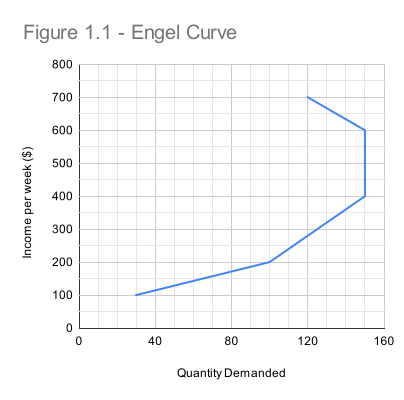
Figure 1.1 represents the relationship between a consumer’s income per week ($) and the corresponding quantity demanded of widgets, displayed in a graphical format.
Question 4
Based on the data in figure 1.1 calculate the following.
a. YED (widgets) given an increase in income per week from $100 to $200
b. YED (widgets) given an increase in income per week from $200 to $400
c. YED (widgets) given an increase in income per week from $400 to $600
d. YED (widgets) given an increase in income per week from $600 to $700
a.
% Change in Quantity Demanded = ((100 – 30) / 30) * 100 = 233.33%
% Change in Income = ((200 – 100) / 100) * 100 = 100%
YED (widgets) = 233.33% / 100% = 2.33
b.
% Change in Quantity Demanded = ((150 – 100) / 100) * 100 = 50%
% Change in Income = ((400 – 200) / 200) * 100 = 100%
YED (widgets) = 50% / 100% = 0.5
c.
% Change in Quantity Demanded = ((150 – 150) / 150) * 100 = 0%
% Change in Income = ((600 – 400) / 400) * 100 = 50%
YED (widgets) = 0% / 50% = 0
Note: even though it is obvious that YED will equal zero, it is still preferable to show your workings out for purposes of the examination.
d.
% Change in Quantity Demanded = ((120 – 150) / 150) * 100 = -20%
% Change in Income = ((700 – 600) / 600) * 100 = 16.67%
YED (widgets) = -20% / 16.67% = -1.20
Author Profile

Latest entries
- May 4, 2023Student ResourcesIncome Elasticity of Demand (YED) Calculations
- March 27, 2023Real World ExamplesIBDP Real World Examples – Policies to Reduce Inequality
- March 27, 2023Real World ExamplesIBDP Real World Examples – Supply-side Policy
- March 27, 2023Real World ExamplesIBDP Real World Examples – Monetary Policy





Comments are closed